
Prerequisites:
- Your Pair custom email address and password. See A Guide to Mailboxes.
- Your incoming and outgoing mail server information. See Finding Your Incoming and Outgoing Servers.
- Thunderbird on a Windows 11 device
Finding Information About Your Account Settings
If you need help finding your username and other configuration settings, see our article, How to Set Up an Email Reader.
Setting Up Your Email with Thunderbird on Windows 11
The process differs depending on whether you’re an established Thunderbird user or you’re setting up Thunderbird for the first time on this device. See instructions for each scenario below:
First Time Thunderbird Setup
Setting up Thunderbird for the first time? Follow these steps to get started.
Note that these instructions are for Thunderbird version 149.0 and may not work for other versions.
- Open Thunderbird on Windows 11
- Fill in the fields:
| Your full name | Enter the name you want to appear in the From field when you send messages. Example: Jane Smith |
| Email Address | Enter your complete email address. Example: [email protected] |
| Password | Enter the password for your email account. |
- Click Configure manually

- Fill in the Incoming and Outgoing Server settings:
| Incoming Server | |
| Protocol | Choose IMAP or POP. See IMAP vs POP: Which Should You Use? |
| Hostname | Enter your incoming mail server. This is usually one of the following formats: - username.mail.pairserver.com - mailX.pair.com To find your exact server name, see Finding Your Incoming and Outgoing Servers. |
| Port | Enter the port number for your account type. Common defaults are IMAP: 993 (SSL/TLS) or POP: 995 (SSL/TLS). Example: 993, 995 |
| Connection Security | Select the encryption type used to secure your connection. Common options include SSL/TLS or STARTTLS. |
| Authentication Method | Select the method your mail client uses to authenticate. |
| Username | Enter your full email address. |
| Outgoing Server | |
| Hostname | Enter your outgoing mail server. This is usually one of the following formats: - username.mail.pairserver.com - mailX.pair.com To find your exact server name, see Finding Your Incoming and Outgoing Servers. |
| Port | Enter the port number for your account type. A common default is 587 (STARTTLS). Example: 587 |
| Connection Security | Select the encryption type used to secure your connection. Common options include SSL/TLS or STARTTLS. |
| Authentication Method | Select the method your mail client uses to authenticate. |
| Username | Enter your full email address. |
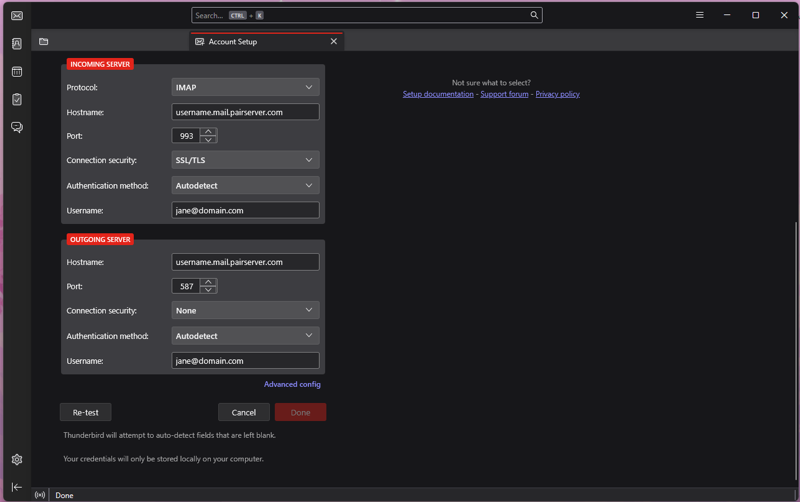
- Click Done.
If the Done button is unavailable, click Re-test to verify your settings. Once the test completes successfully, Done becomes available. - Click Finish
Adding an Additional Email to Thunderbird (via Account Hub)
After you add your first account, Thunderbird may automatically enable its experimental Account Hub workflow for adding additional accounts.
- Open Thunderbird on Windows 11
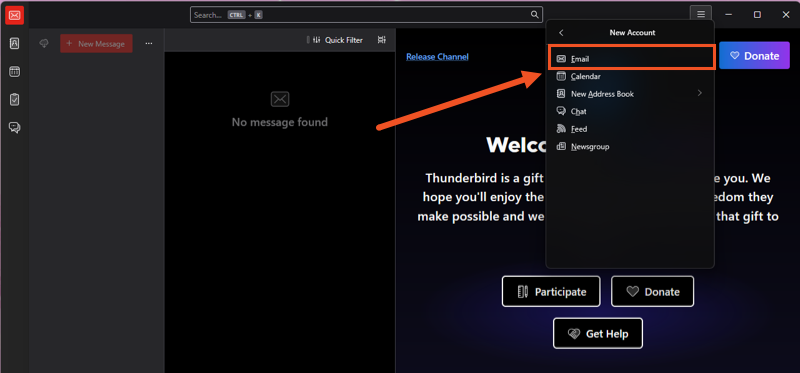
- Click the menu button (☰) in the upper right corner
- Click New Account
- Click Email
- Enter the following information:
| Full Name | Enter the name you want to appear in the From field when you send messages. Example: Jane Smith |
| Email Address | Enter your complete email address. Example: [email protected] |

- Click Continue
- Click Edit Configuration.
- Fill in the Incoming Server Settings:
| Protocol | Choose IMAP or POP. See IMAP vs POP: Which Should You Use? |
| Hostname | Enter your incoming mail server. This is usually one of the following formats: - username.mail.pairserver.com - mailX.pair.com To find your exact server name, see Finding Your Incoming and Outgoing Servers. |
| Port | Enter the port number for your account type. Common defaults are IMAP: 993 (SSL/TLS) or POP: 995 (SSL/TLS). Example: 993, 995 |
| Connection Security | Select the encryption type used to secure your connection. Common options include SSL/TLS or STARTTLS. |
| Authentication Method | Select the method your mail client uses to authenticate. |
| Username | Enter your full email address. |
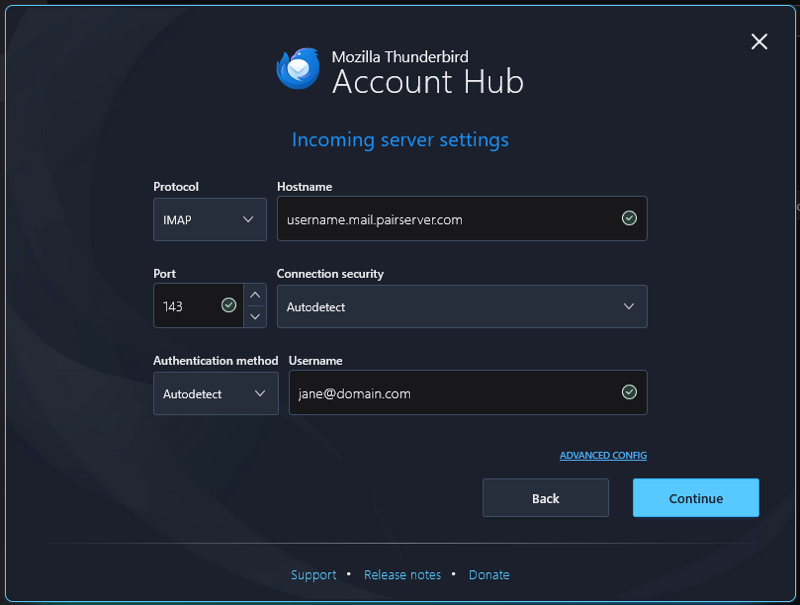
- Click Continue
- Fill in the Outgoing Server Settings:
| Protocol | The protocol used for sending mail. Thunderbird uses SMTP for all outgoing mail. |
| Hostname | Enter your outgoing mail server. This is usually one of the following formats: - username.mail.pairserver.com - mailX.pair.com To find your exact server name, see Finding Your Incoming and Outgoing Servers. |
| Port | Enter the port number for your account type. A common default is 587 (STARTTLS). Example: 587 |
| Connection Security | Select the encryption type used to secure your connection. Common options include SSL/TLS or STARTTLS. |
| Authentication | Select the method your mail client uses to authenticate. |
| Username | Enter your full email address. |

- Click Test
- Click Continue
- Enter the password for your email account
- Click Continue
- Choose any address books or calendars you would like to sync to your account
- Click Continue
- Click Finish
Turning Off the Account Hub Feature
If you run into errors or an infinite loading bug when adding additional accounts through the Account Hub feature, you can temporarily disable Account Hub by following these steps:
- Open Thunderbird on Windows 11
- Click the menu button (☰) in the upper right corner
- Click Settings
- In the Account Hub section, uncheck Create accounts in the new Account Hub
After disabling this option, follow the steps in the First Time Thunderbird Setup tutorial above to add additional email addresses to Thunderbird.
Using SSL to Secure Your Email
Pair Networks provides support for SSL/TLS and STARTTLS encryption for all IMAP, POP, and authenticated SMTP connections. Using encryption is an important way to prevent your password from being stolen.
POPS/IMAPS only secures the connection between your email reader and the mail server. Once it reaches the mail server, it will be in plain text. For additional security, you would need to encrypt the email message itself. The port for POPS is 995, the port for the IMAPS is 993, and the ports for encrypted authenticated SMTPAUTH are 465 and 587. These are the standard ports for these services, and you should not need to manually set them.
Please note that we replaced the secure certificate used to provide POPS, IMAPS, and SMTPS email services (sending and receiving email over SSL). Our SSL certificate vendor has changed to a new "root" certificate, which is recognized by most, but not all, email programs. If your email program begins returning errors and indicates that the server certificate is not recognized, please download the root certificate below and install it in your email program. The specifics of how to install a certificate will vary from program to program -- please consult the help files of your program for details.
Please also note that our mail servers use an SSL certificate. If you use this SSL option in conjunction with a domain name, your email reader may warn you that the domain names do not match. Some email readers will allow you to ignore this warning. In these cases, your incoming email will remain secure.
However, some email readers will not let you proceed if the security certificates do not match. If this occurs, please verify your incoming server settings as follows:
For accounts created prior to June 1, 2011, the email server will follow this formula:
mailX.pair.com
(where X is your server number)
For accounts created on or after June 1, 2011, the email server will follow this formula:
username.mail.pairserver.com
(where "username" is your main account username)