
Shared VPS Dedicated WP Professional WP Professional Plus
Imagine you're managing a website with hundreds of files organized into multiple directories. One day, you realize that two separate directories need access to the same image file. Rather than duplicating the file (and wasting storage space), you're stuck copying and pasting it every time something changes. It's tedious, inefficient, and prone to error. That's where symbolic links come in.
Whether you're a developer managing shared assets, or a site owner trying to maintain consistency across your content, symbolic links (or "symlinks") allow you to reference a file or folder in one location while accessing it from another. With just a few commands or clicks in your control panel, you can connect resources across your web hosting environment without redundancy.
What is a Symlink?
A symbolic link creates a file in your directory and acts as a shortcut to a file or folder.
For example: I have a directory - let's say example.com. However, I want a shortcut to another directory within the example.com. To do this, you would create a symbolic link.
The symbolic link shows up as a link within the directory. It shows the file path of the symbolic link in the Size, Permissions, Date columns.

After it's been created, you can click on the symbolic link's file path in the directory to quickly navigate to a new location.

Hard Link vs Symlink
Hard links and symbolic links are both types of references to files, but they work in different ways. A hard link is essentially a mirror copy of the file that points to the same data on the disk. If you modify the data through one hard link, it reflects in all other hard links to that file. Hard links cannot reference directories and must be on the same filesystem.
Symbolic links, on the other hand, act more like shortcuts. They reference the original file by its path, and if the original is deleted or moved, the symlink breaks. Symbolic links can also point to directories and span multiple filesystems, making them more flexible in many web hosting environments.
Junction vs Symbolic Link
Junctions are a type of reparse point used in Windows environments to link directories. Like symbolic links, junctions create pointers to other directories. However, junctions are limited to directories (not individual files) and must reside within the same local volume. Symbolic links, especially on Unix-based systems, are more versatile and commonly used in web hosting scenarios.
Creating a Symlink in the ACC
You can create a symbolic link directly in the Account Control Center (ACC). To do so, follow these steps:
Choose the tutorial that reflects your ACC interface type:
- Legacy Interface
- New ACC Interface
Not sure what the difference is? See Which ACC Interface Am I Using?
If you are using the Legacy Interface:
- Log in to your Account Control Center (ACC)
- In the left sidebar, click Files
- In the drop-down, click the directory you wish to visit. You can choose between:
- Home
- Web
- FTP
- Once in your directory of choice, navigate to the location where you wish to place the symbolic link.
For example, if you want your symbolic link in a sub directory named Example, then you should open the Example directory before completing the next steps. - In the top navigation bar, click the Create Link button
- On the next page, double-check the Current Directory file path and make sure it is correct. This is the file path to the location where the symbolic link will be placed.
- Next, fill out the fields:
Source Filename This should be the file path to the new location you want the symbolic link to link to. Link Filename This is a nickname for the symbolic link so that you can easily identify it. - Once the fields have been filled out, click the Make Symbolic Link button
The new symbolic link will appear in the directory where you placed it.
If you are using the New ACC Interface:
- Log in to your Account Control Center (ACC) at my.pair.com
- In the top navigation bar, click Files
- Navigate to the directory where you want to place the symbolic link
- In the toolbar, click the Create Link button
- On the next page, double-check the Current Directory file path and make sure it is correct. This is the file path to the location where the symbolic link will be placed.
- Next, fill out the fields:
| Source Filename | This should be the file path to the new location you want the symbolic link to link to. |
| Link Filename | This is a nickname for the symbolic link so that you can easily identify it. |
- Once the fields have been filled out, click the Make Symbolic Link button
The new symbolic link will appear in the directory where you placed it.
Creating a Symlink via SSH
If you prefer to use a terminal or command prompt to create a symbolic link, you can do that, too. To do so, follow these steps:
- Connect to your hosting account via SSH
- Use ls and cd to navigate to the directory where you would like the symbolic link to be placed
ln -s [source-filename] [link-filename]
Replace [source-filename] with the file or folder you want to link to and the [link-filename] with what you want to name the link.
For example, this could look like:
ln -s /usr/home/username/public_html/directory1 MyNewSymlink
This will create a symbolic link in your current location.
How to Delete a Symbolic Link in the ACC
Once you have created a symbolic link in the Account Control Center, it will appear in your file directory. However, if you no longer require the symbolic link, you can delete it by following these steps:
Choose the tutorial that reflects your ACC interface type:
- Legacy Interface
- New ACC Interface
Not sure what the difference is? See Which ACC Interface Am I Using?
If you are using the Legacy Interface:
- Navigate to the file directory where your symbolic link was created
- Find your symbolic link. It will have an arrow icon next to it, like in the example image below

- Click on the link name
- On the next page, click the Delete button in the toolbar
- The next page will ask you to confirm. Click the Delete button to do so.
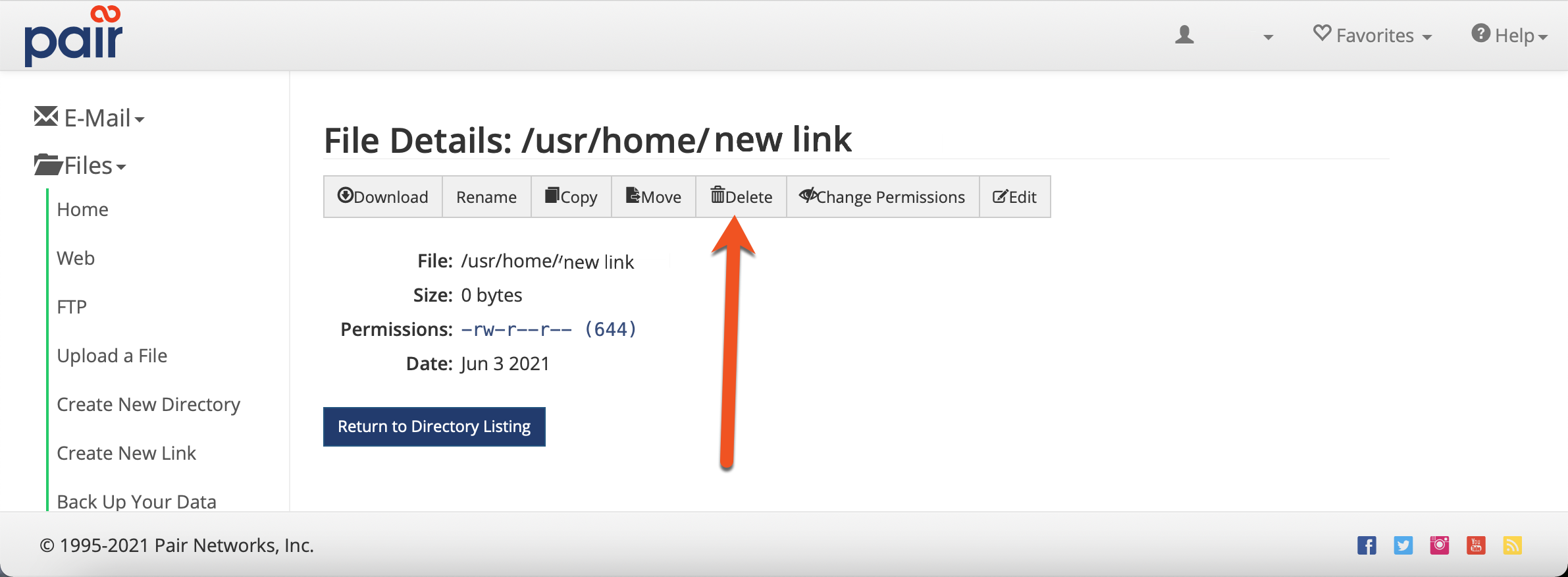
If you are using the New ACC Interface:
- Navigate to the file directory where your symbolic link was created
- Find your symbolic link
- Click the Action button
- Click Delete in the drop-down
- Confirm the deletion by clicking the Delete button
How to Delete a Symbolic Link via SSH
If you prefer to use a terminal or command prompt to delete a symbolic link:
- Connect to your hosting account via SSH
- Use ls and cd to navigate to the directory where the symbolic link you want to remove is located
- Once there, run the command:
unlink [link-filename]The symbolic link will be deleted.
No matter how efficiently you manage your site with tools like symbolic links, unexpected data loss or file changes can still occur. To keep your website secure and ensure quick recoveries, make regular backups a part of your routine. Pair Networks offers reliable site backup solutions that give you peace of mind and the ability to restore your content swiftly when needed.